What is Vibe Coding?
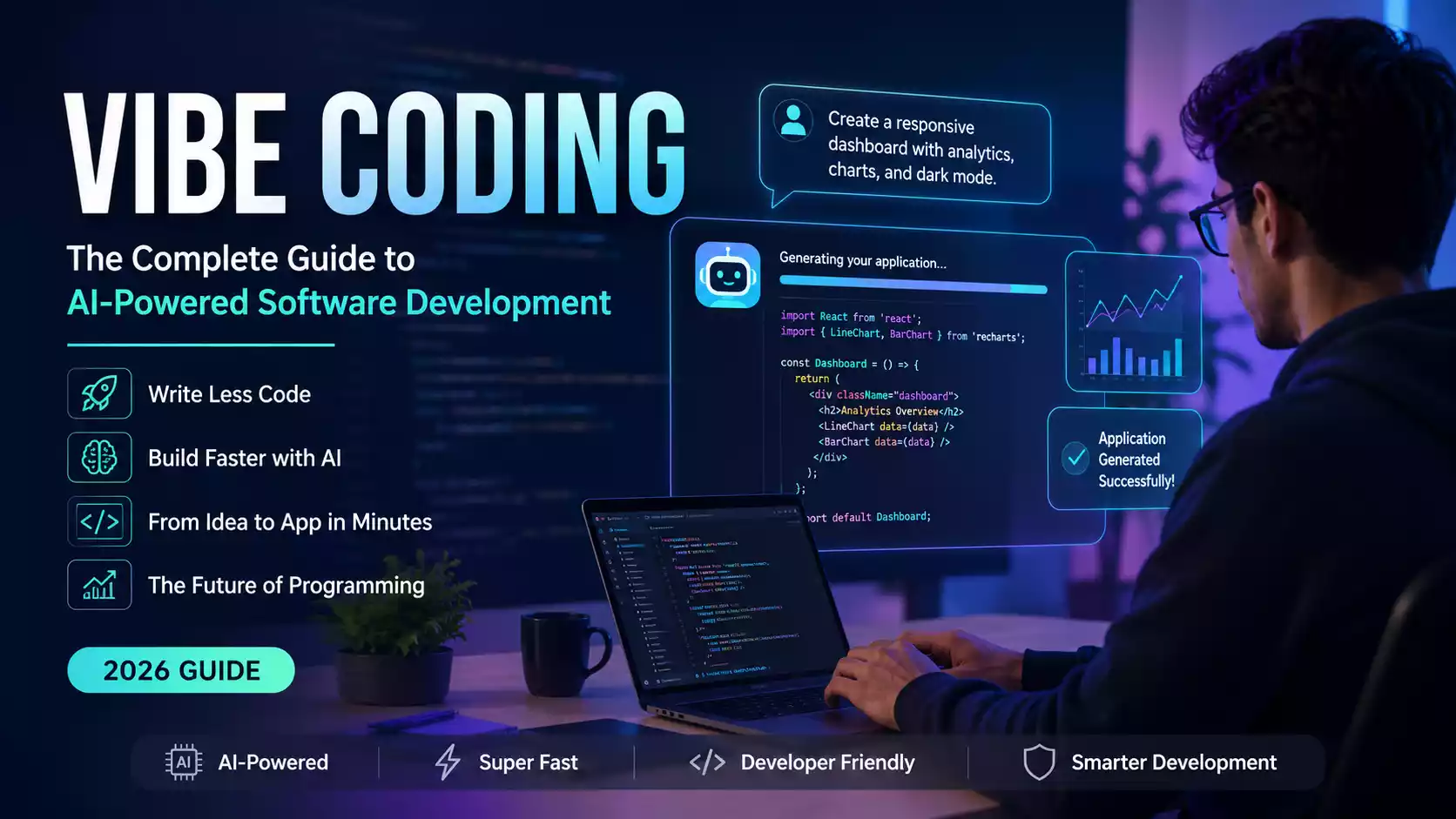
Vibe coding is a software development approach where developers describe what they want to build in natural language and artificial intelligence generates part or all of the required code.
Instead of manually writing every function, class, or API endpoint, the developer focuses on communicating goals while AI handles much of the implementation.
In simple terms:
Vibe Coding is programming through intent rather than syntax.
This emerging approach is changing how startups, developers, students, and entrepreneurs create software.
Table of Contents
- What is Vibe Coding?
- Why is Vibe Coding Trending?
- The Origin of the Term
- How Vibe Coding Works
- Real Example of Vibe Coding
- Statistics and Industry Trends
- Best Vibe Coding Tools
- Comparison Table
- Benefits of Vibe Coding
- Limitations and Risks
- Case Study: Building an MVP with AI
- Is Vibe Coding Replacing Developers?
- Future of Vibe Coding
- FAQs
- Author Bio
- References
Why is Vibe Coding Trending?
The software industry is experiencing a major shift due to advances in Generative AI, Large Language Models (LLMs), and AI coding assistants.
Several factors are driving the trend:
Faster Product Development
Applications that once required weeks can now be prototyped in days.
Lower Entry Barriers
Non-programmers can create functional products without mastering programming languages.
Startup Advantage
Founders can validate business ideas faster and at lower costs.
Increased Developer Productivity
Experienced engineers spend less time on repetitive coding tasks and more time on architecture and problem-solving.
The Origin of the Term “Vibe Coding”
The phrase “Vibe Coding” became popular within the developer community as AI coding tools matured.
The idea reflects a workflow where developers focus on the “vibe” or intended outcome of software rather than manually crafting every line of code.
Rather than saying:
Write 500 lines of React code.
Developers now say:
Build a responsive dashboard with user authentication, analytics, dark mode, and mobile support.
AI generates the initial implementation.
How Vibe Coding Works
Step 1: Define the Goal
The developer describes the desired application.
Example:
“Create a project management application where users can create, assign, and track tasks.”
Step 2: AI Generates Code
The AI produces:
- Frontend components
- Backend APIs
- Database schemas
- Authentication systems
Step 3: Refinement
Developers improve outputs through additional prompts.
Examples:
- Add notifications.
- Improve performance.
- Optimize mobile experience.
Step 4: Testing and Deployment
Human review remains essential before production deployment.
Real Example of Vibe Coding
Imagine a founder wants to launch a school management application.
Traditional Approach:
- Requirements gathering
- UI design
- Frontend development
- Backend development
- Testing
Estimated time:
4–8 weeks
Vibe Coding Approach:
Prompt:
Build a school management platform with student registration, attendance tracking, teacher dashboard, fee management, and mobile-friendly design.
AI generates the initial system within hours.
Developers then refine and secure the application.
Statistics and Industry Trends
The rise of AI-assisted programming has been remarkable.
Key observations from industry reports:
- AI coding assistants are now used by millions of developers worldwide.
- Many development teams report measurable productivity gains from AI-assisted coding.
- Startups increasingly use AI tools during MVP development.
- Venture-backed companies are integrating AI development workflows into their engineering processes.
These trends suggest that AI-assisted development is becoming a standard industry practice rather than an experimental concept.
Best Vibe Coding Tools in 2026
Cursor
Designed specifically for AI-assisted development.
Best for:
Professional developers.
GitHub Copilot
Integrated directly into development environments.
Best for:
Code completion and productivity.
ChatGPT
Useful for:
- Code generation
- Debugging
- Architecture planning
- Documentation
Best for:
General-purpose AI development assistance.
Claude
Strong at handling large codebases and detailed reasoning.
Best for:
Complex projects.
Replit AI
Cloud-based development platform.
Best for:
Rapid prototyping.
Vibe Coding Tools Comparison
| Tool | Best For | Difficulty | AI Capability |
|---|---|---|---|
| Cursor | Full-stack development | Medium | High |
| GitHub Copilot | Coding assistance | Low | High |
| ChatGPT | General AI development | Low | High |
| Claude | Large projects | Medium | Very High |
| Replit AI | Beginners | Low | Medium |
Benefits of Vibe Coding
1. Faster Development
Projects move from idea to prototype significantly faster.
2. Lower Costs
Smaller teams can accomplish more.
3. Improved Creativity
Developers focus on solving problems rather than repetitive coding.
4. Better Learning Experience
Beginners learn through generated examples.
5. Rapid Experimentation
Businesses can test multiple ideas quickly.
Limitations and Risks of Vibe Coding
Security Issues
AI-generated code may contain vulnerabilities.
Scalability Challenges
Generated solutions are not always optimized for large-scale systems.
Over-Reliance on AI
Developers still need strong problem-solving skills.
Technical Debt
Poorly reviewed AI-generated code can become difficult to maintain.
Hallucinations
AI occasionally generates incorrect implementations.
Case Study: Building an MVP with AI
To understand the practical impact of vibe coding, consider a startup building a local community platform.
Requirements:
- User registration
- Posts and comments
- Business listings
- Interactive map
Using traditional development:
Estimated timeline:
4–6 weeks
Using AI-assisted development:
- Database generated in minutes
- APIs scaffolded automatically
- Frontend components generated rapidly
- Documentation created instantly
Result:
A working prototype can often be achieved in a fraction of the traditional development time.
The final product still requires testing, security review, and optimization.
Is Vibe Coding Replacing Developers?
No.
Vibe coding changes the role of developers rather than eliminating it.
Developers remain essential for:
Architecture Design
Large systems require strategic planning.
Security
Human review remains critical.
Performance Optimization
AI-generated code is not always efficient.
Business Logic
Complex requirements still need human understanding.
The most valuable professionals in the future will likely be those who combine software engineering expertise with effective AI collaboration.
The Future of Vibe Coding
Several developments are expected over the next few years:
- AI-generated applications from a single prompt
- Automated software testing
- AI-driven debugging
- Autonomous deployment systems
- Real-time collaborative AI development
Organizations that adapt early may gain significant competitive advantages.
Frequently Asked Questions
What is vibe coding?
Vibe coding is the practice of building software primarily through natural language instructions given to AI systems.
Is vibe coding suitable for beginners?
Yes. It enables beginners to create projects while learning development concepts.
Which programming languages support vibe coding?
Most modern languages including Python, JavaScript, TypeScript, Java, C#, and Go.
Can vibe coding create production-ready applications?
Yes, but generated code should always be reviewed, tested, and secured.
What is the best vibe coding tool?
Cursor, ChatGPT, Claude, GitHub Copilot, and Replit AI are among the most popular choices.
Related Articles
To build topical authority, internally link this article to:
Author Bio
Rohit Kumar is the Founder and CEO of ScrollAR4U Technologies Private Limited. He works in software development, augmented reality, AI-powered education solutions, and startup innovation. His experience includes building mobile applications, educational technology products, and AI-assisted software solutions.
Key Takeaway
Vibe coding represents one of the most significant shifts in software development since the introduction of modern programming frameworks. By enabling developers to communicate intent rather than manually write every implementation detail, AI is making software creation faster, more accessible, and more efficient. While traditional programming skills remain valuable, the ability to effectively collaborate with AI tools is rapidly becoming a core skill for the next generation of software builders.